

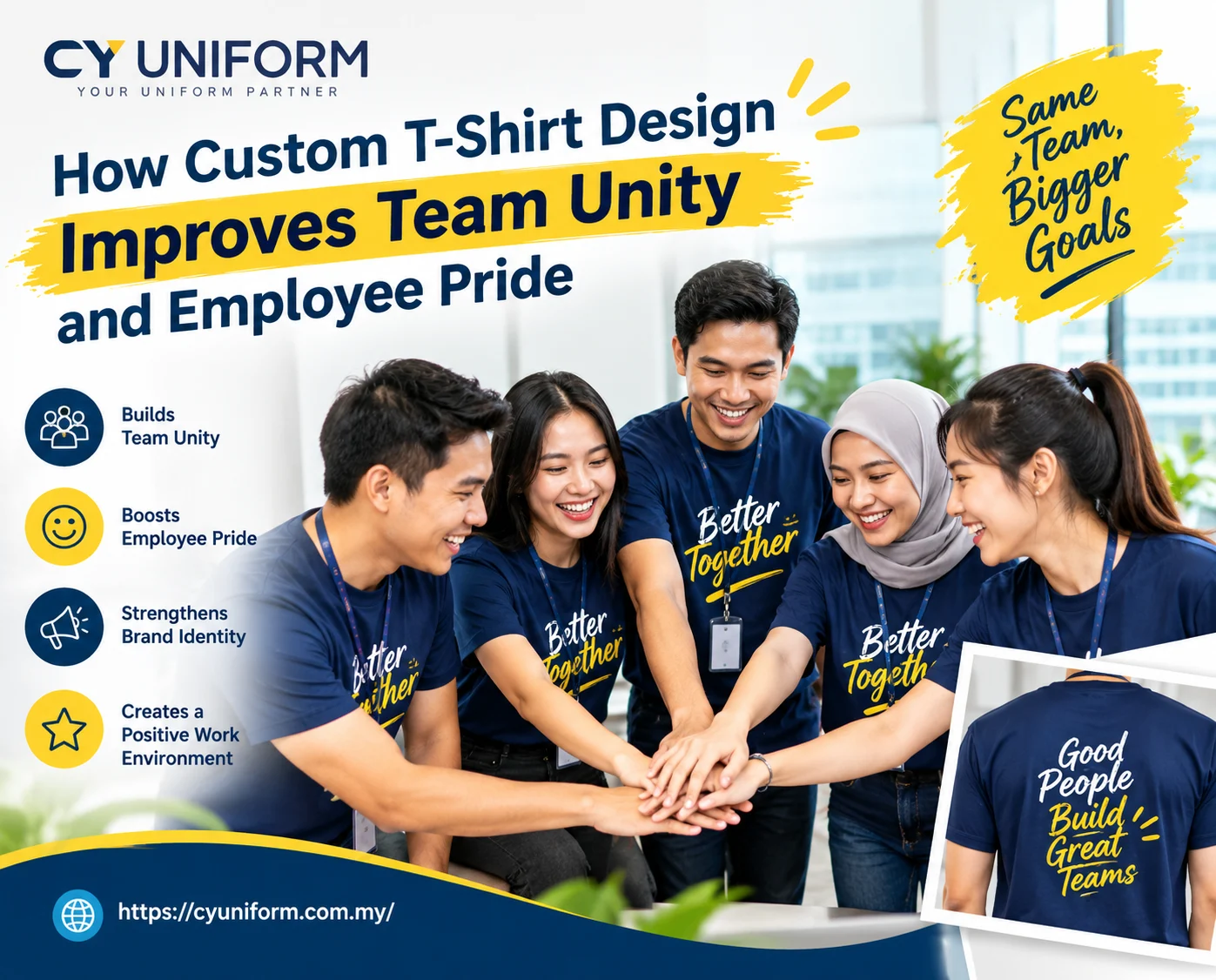
Walk into any office, warehouse or event site in Malaysia, and you can usually tell within seconds whether a team feels connected. Sometimes it’s how people talk to each other. Sometimes it’s just what they’re wearing.
A well-thought-out Company T Shirt Design Malaysia businesses actually enjoy wearing does more than look neat in photos. It quietly shapes how a team feels about itself, day after day. CY Uniform has seen this play out with clients across retail, F&B, events and corporate offices — the shirt is small, but its effect on morale is not.
Shared Clothing Creates a Shared Identity
Humans are wired to bond over shared symbols. Sports fans wear jerseys. Families wear matching outfits at reunions. Teams are no different.When everyone on staff puts on the same shirt, something shifts. Individual roles fade into the background for a moment, and a collective identity takes over. The intern and the manager look, for a second, like equals — part of the same unit, working toward the same goal.
This matters more than most business owners realise. Teams that feel like a “unit” tend to communicate better, cover for each other during busy shifts, and generally have less friction. A custom T-shirt won’t fix a broken culture on its own, but it reinforces a healthy one every single day.
It Removes Invisible Hierarchies
Office wear can unintentionally highlight differences. Someone in a sharp blazer looks senior. Someone in a plain polo looks junior. These small visual cues add up, even if nobody intends them to.
Uniform T-shirts flatten that. Everyone, from the newest hire to the department head, wears the same design. This doesn’t erase leadership structure, but it does remove one more unconscious signal that separates people. Teams that feel less divided by appearance tend to collaborate more freely.
This is especially useful for companies going through rapid hiring or restructuring, where new employees need to feel like they belong from day one, not months later.
Pride Comes From Design, Not Just Ownership
Handing someone a shirt with the company logo doesn’t automatically make them proud to wear it. If the design looks outdated, cheap, or thrown together, employees will treat it as an obligation rather than something they choose to wear.
Pride shows up when the shirt actually looks good. That means:
● A logo that’s sized and placed properly, not stretched or squeezed onto the fabric
● Colours that suit the industry and don’t look faded after a few washes
● A cut and fabric that’s comfortable enough to wear for a full shift, not just a photo
When these details are handled well, something interesting happens — employees start wearing the shirt beyond work hours. That’s usually the clearest sign that a design has succeeded.
Involving Employees Builds Ownership
One thing many companies overlook is that pride grows faster when people feel some ownership over the outcome, not just the object.Simple steps make a difference here. Asking staff for colour preferences. Running a quick poll on two design options before printing. Letting a department pick between two shirt cuts. None of this requires a full committee — even small input changes how people relate to the final product.
At CY Uniform, this is something we often suggest to clients who are redesigning uniforms after a rebrand or expansion. A shirt the team helped shape, even in a small way, gets worn with more enthusiasm than one that simply appeared in a box one Monday morning.
Events Are Where Unity Becomes Visible
Nowhere does a shared T-shirt do more work than at company events — annual dinners, sports days, CSR activities, product launches. When a hundred people wearing the same design move through a venue together, it sends a message before anyone says a word: this is one team.
Photos from these events also tend to circulate longer, internally and sometimes externally. A design that photographs well and looks intentional adds to that sense of pride long after the event ends.
Companies that treat these moments seriously — rather than printing whatever’s cheapest and fastest — usually see it reflected in how enthusiastically staff show up and participate.
A Small Cost With a Long-Term Return
Some businesses hesitate over uniform budgets, treating them purely as an operational expense. But the return isn’t just visual. Teams with a stronger sense of unity typically report:
● Better day-to-day cooperation between departments
● Lower friction during high-pressure periods like peak seasons
● Higher willingness to represent the company at external events
None of this shows up directly on an invoice, but it shows up in how a workplace actually feels to be part of.
Getting the Design Right Matters
A rushed uniform design rarely earns the reaction a business is hoping for. Getting the fit, fabric, colours and logo placement right takes a bit of back-and-forth — and that’s where working with an experienced printer helps.
CY Uniform works closely with companies across Malaysia to turn a basic logo and colour palette into a shirt that people are genuinely glad to wear, whether that’s for daily operations or a one-off event. The goal isn’t just a finished order. It’s a shirt that does its quiet job of pulling a team closer together.
Conclusion
A T-shirt seems like a minor line item in a company’s budget, but its effect on team culture is anything but small. It softens hierarchies, gives people a shared identity, and — when designed thoughtfully — turns into something staff are proud to put on. For any Malaysian business planning uniforms or event apparel, the design decisions made early on will quietly shape team morale for months, if not years, after the shirts are printed.
Frequently Asked Questions
1. Does a company T-shirt really affect employee morale?
Yes. Shared clothing creates a sense of belonging and reduces visible hierarchy between staff, which tends to improve day-to-day cooperation.
2. What makes employees actually want to wear their company shirt?
Good fit, comfortable fabric, and a clean, well-placed logo. If a shirt looks lazy or feels uncomfortable, staff will avoid wearing it outside work hours.
3. Should employees be involved in the design process?
Where possible, yes. Even small input, like choosing between two colour options, increases how much ownership and pride staff feel toward the final design.
4. Are event T-shirts different from everyday uniform shirts?
They can serve different goals. Event shirts focus on visual impact and group identity for a single occasion, while daily uniforms need to hold up to repeated wear and washing.
5. How does CY Uniform help with this?
CY Uniform works with Malaysian businesses to design and print T-shirts that balance branding, comfort and practicality, so teams end up with apparel they’re actually proud to wear.